Every few months a romance novel becomes a film or a series and a wave of people go looking for the book — usually after watching. The adaptations are rarely faithful, and that's the interesting part: what a director keeps, cuts or softens tells you what the book was actually doing. Here are the romance adaptations worth knowing, what changed on the way to the screen, and where to find both.
The BookTok-era adaptations
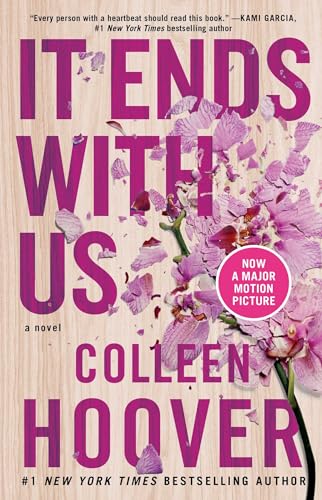
It Ends with Us: A Novel — Colleen Hoover
The book that made Colleen Hoover a household name, and the adaptation that made the discourse louder. Lily Bloom opens a flower shop in Boston and falls for a neurosurgeon whose temper surfaces slowly. The novel is told entirely in Lily's interiority, which is how it earns its ending; the film has to externalise that, so it leans on Blake Lively's performance to carry what the prose does in first person. Read the book if you want the reasoning rather than the result.

The Idea of You: A Novel — Robinne Lee
A 39-year-old gallery owner falls for the 24-year-old frontman of a boy band. The novel is sharper and sadder than the film — Lee is interested in how the world punishes a woman for the relationship, and the ending reflects that. The adaptation, with Anne Hathaway, softens it considerably. Both are good; they are not the same story, and the change is worth noticing.

Red, White & Royal Blue: A Novel — Casey McQuiston
The First Son of the United States and a British prince start as tabloid rivals. The book is very funny and structurally odd — long stretches are email and text, which is exactly the thing film can't do. The adaptation replaces that correspondence with screen time together, so the slow burn is compressed. The novel is the better version of the romance; the film is the better version of the fantasy.
The ones that made people cry in cinemas

Me Before You: A Novel — Jojo Moyes
Louisa Clark takes a job as a carer for Will Traynor, a former City banker paralysed in an accident. Moyes wrote the screenplay herself, which is unusual and shows — the film is closer to the book than most on this list. What it loses is the supporting cast's interiority, particularly Lou's family, which in the novel is where a lot of the class commentary lives.

To All the Boys I've Loved Before — Jenny Han
Lara Jean's private love letters get mailed. The Netflix adaptation is one of the rare cases where the film arguably improved the property's reach without damaging it — it's warm, well cast, and faithful to the tone. The books go further into the sisters' relationship and Lara Jean's grief for her mother, which the trilogy of films only partly carries.
Series, not films

Heated Rivalry — Rachel Reid
Two star NHL players from rival teams, one secret relationship spanning years. The book is a slow-burn told in time jumps across seasons, which is a structure television is actually well suited to — the adaptation gets to give each reunion its own episode. If you only know hockey romance from Icebreaker, this is the other end of the subgenre: adult, quieter, sadder.

Conversations with Friends: A Novel — Sally Rooney
Rooney's first novel, and the harder of her two adaptations. Frances and Bobbi, former girlfriends and still best friends, become entangled with an older married couple. Almost all of the book happens inside Frances's head and in instant messages; the series has to make that visible, and the result is more muted than the prose. Read it for the dialogue, which is the point.
The classics that keep getting remade
Jane Austen is the most adapted romance novelist in history, and the versions differ so much that choosing one is really choosing an interpretation. The 2005 Pride & Prejudice is the romantic one — mud, rain, dawn light. Emma (2020) plays the comedy as farce and looks like a pastry. Persuasion (2022) divided people by making Anne Elliot a modern narrator who talks to camera. Sense and Sensibility (1995), adapted by Emma Thompson, is still the most emotionally intelligent of the lot.
Beyond Austen, Wuthering Heights (2026) is the current attempt at Brontë's least romantic romance — a book people persistently misremember as a love story rather than a study of obsession. And Atonement (2007) remains the best argument that a faithful adaptation can still devastate you differently: the film's final revelation lands through performance where the novel lands through structure.
When the book and the film disagree
A pattern worth noticing across this list: adaptations soften. Endings get warmer, ambiguity gets resolved, and the cost the heroine pays usually gets reduced. The Idea of You is the clearest example, but it happens in It Ends with Us and Conversations with Friends too.
That isn't a criticism of the films so much as a description of what the two forms are for. A novel can sit inside a character's reasoning for three hundred pages and let you disagree with her. A film has ninety minutes and a face. If you liked the adaptation and want the version with the interior argument intact, the book is nearly always the sharper object.
You can browse everything currently streaming in our romance movies and romance TV series guides, or filter the full book catalogue by trope and heat level to find the source novels.